

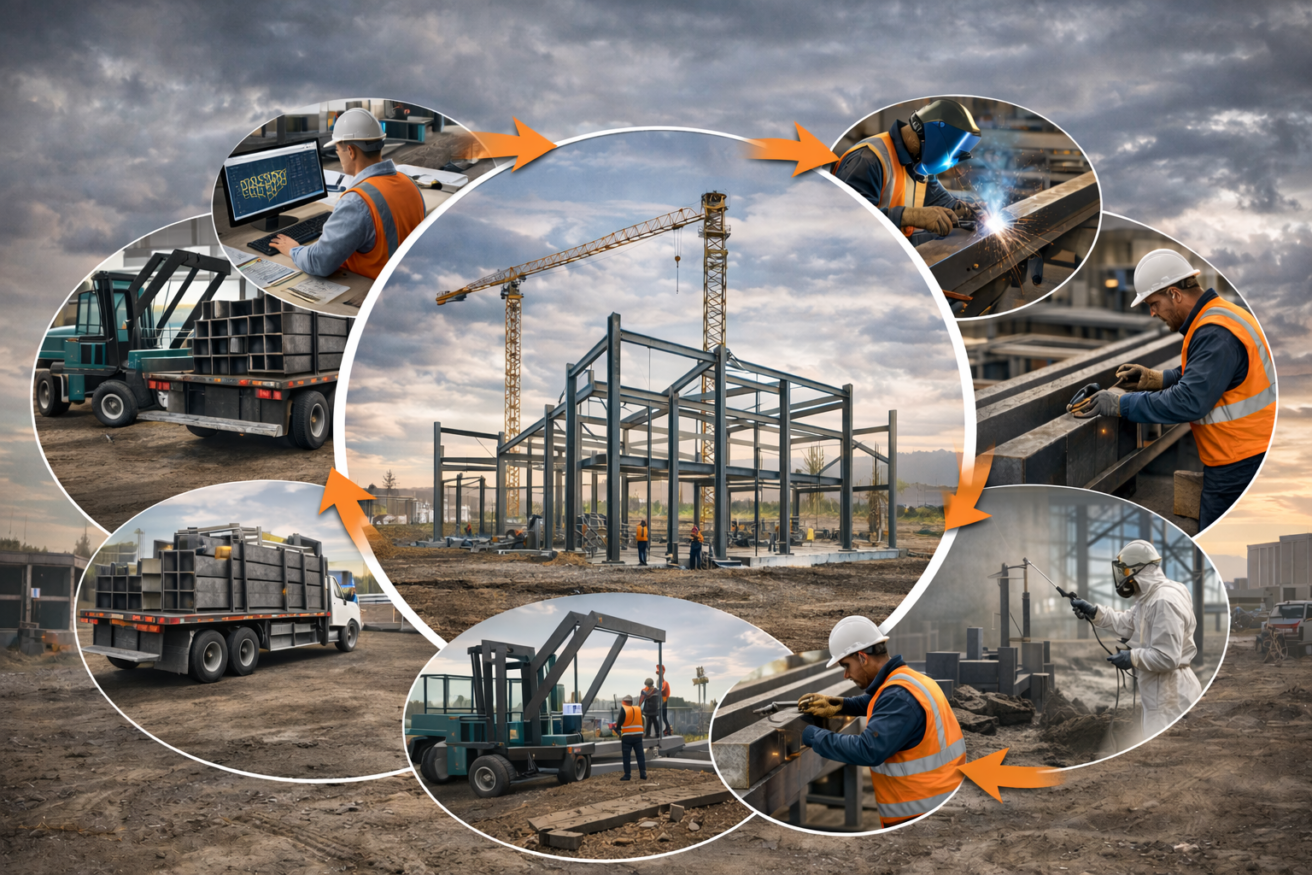
Structural steel forms the backbone of modern construction across the UAE. High-rise towers, industrial plants, airports, warehouses, transport infrastructure, and iconic architectural landmarks all depend on it. The complete lifecycle of structural steel fabrication is a coordinated engineering process starting with conceptual design and moving through precision fabrication, protective treatment, logistics, and final site installation. Every stage matters for ensuring safety, durability, cost-efficiency, and long-term performance.
In the UAE’s construction environment—where timelines stay tight, quality expectations run high, and regulatory compliance is mandatory—understanding this lifecycle becomes essential for developers, consultants, and contractors.
Conceptual Design and Precision Engineering
The lifecycle starts with engineering design and structural planning. Architects and structural engineers translate architectural vision into load-bearing steel systems capable of resisting dead loads from the structure itself, live loads from occupants and equipment, wind loads due to open terrain and tall buildings, thermal stresses from extreme heat variations, and seismic forces where applicable.
Performance-based structural design gets widely adopted in the UAE, particularly for high-rise and complex buildings. Engineers use advanced CAD and BIM platforms like Tekla Structures, Revit, STAAD, and ETABS to simulate real-world load behavior and optimize steel section selection.
BIM integration has become standard practice across major UAE projects. It lets multiple stakeholders—designers, fabricators, consultants, and MEP contractors—coordinate within a shared digital environment. This reduces clashes, cuts down errors, and shortens approval cycles.
Fire resistance, corrosion exposure (especially in coastal zones like Dubai and Abu Dhabi), and service life expectations also get evaluated during this early design phase. This ensures full compliance with UAE Fire and Life Safety Codes and municipal regulations.
Shop Drawings and Connection Detailing
Once structural design gets approved, the next step involves producing shop drawings and detailed connection drawings. These documents convert engineering intent into fabrication-ready instructions and include exact dimensions of beams, columns, and bracing members, welding symbols and weld sizes with inspection requirements, bolt grades with spacing and hole locations, plate thicknesses and built-up member details, and surface treatment with fire protection specifications.
In the UAE, shop drawings typically undergo multiple reviews and approval rounds by consultants, project managers, and authorities before fabrication begins. High-quality connection detailing becomes especially critical for large-span structures, transfer beams, and seismic-resistant systems.
Strategic Material Procurement and Verification
After drawing approvals, material procurement begins. Selected steel grades must match both structural requirements and environmental exposure conditions. All incoming materials face strict quality verification using Mill Test Certificates that confirm chemical composition, yield strength, tensile strength, elongation values, and impact resistance.
In the UAE, traceability is a critical compliance requirement, especially for projects audited by government bodies, international consultants, and insurance agencies.
Steel Preparation, Cutting, and CNC Processing
Once verified, raw steel gets prepared for fabrication. Preparation includes straightening distorted members, removing surface contaminants, and applying layout markings for precision processing.
Cutting and shaping happen through modern CNC-controlled machinery—fiber laser cutting, CNC plasma cutting, and heavy oxy-fuel cutting. Direct digital transfer from BIM models ensures high-dimensional accuracy, efficient nesting, and minimal material wastage. This matters for structural steel fabrication projects executed at scale across the UAE.
Forming, Bending, and Built-Up Member Fabrication
Certain architectural and industrial structures need curved or angular steel components. These get produced through press braking, plate rolling, and section bending.
For large-span structures, built-up members are fabricated by welding multiple steel plates together to form custom structural sections. These elements commonly appear in long-span trusses, crane girders, and heavy industrial frames.
Assembly, Welding, and Dimensional Control
At this stage, individual cut components get assembled using temporary fit-up arrangements and tack welding before permanent welding happens.
Welding is performed strictly according to approved Welding Procedure Specifications and is carried out by certified welders using MIG, TIG, Submerged Arc, and Flux-Cored Arc welding techniques. Post-welding straightening corrects heat-induced distortion and ensures dimensional accuracy.
Non-Destructive Testing and Quality Assurance
Quality control runs throughout the fabrication process, but becomes most intensive after welding. Non-destructive testing methods such as ultrasonic testing, magnetic particle testing, radiographic testing, and dye penetrant testing confirm weld integrity.
These inspections ensure fabricated components meet international safety standards and strict UAE project acceptance criteria.
Surface Treatment, Corrosion Protection, and Fire Protection
Given the UAE’s harsh climate—high humidity, salinity, and extreme heat—surface protection ranks as one of the most critical stages of structural steel fabrication.
Corrosion Protection
Protective systems include zinc-rich primers, epoxy intermediate coatings, polyurethane topcoats, and galvanizing for marine and industrial environments.
Fire Protection
To comply with the UAE Fire and Life Safety Code and Dubai Civil Defence regulations, fire protection systems such as intumescent coatings, cementitious fireproofing sprays, fire-rated boards, or concrete encasement are applied as required.
Trial Assembly, Packing, and Transportation
For complex structures, trial assembly happens at the fabrication yard to verify fit-up, alignment, and connection accuracy. This minimizes installation risks at the site.
Components then get labeled according to erection sequence, carefully packed to protect coatings, and transported under controlled logistics planning.
Many steel structure companies in Dubai specialize in heavy transport planning for oversized components that require escort approvals, route surveys, and restricted movement schedules.
On-Site Erection and Structural Installation
The final phase of the lifecycle is site installation. Using high-capacity cranes and bolting systems, steel members are erected systematically based on the approved method statement. This includes column installation, beam placement, bracing erection, and final bolting or field welding.
Strict safety protocols apply throughout the erection process in line with UAE construction safety regulations.
Why the Complete Lifecycle Matters in UAE Construction
Understanding the full lifecycle allows clients to maintain consistent quality across all project stages, avoid hidden delays and costly site corrections, ensure legal and fire safety compliance, reduce long-term maintenance risks, and secure higher asset durability.
For developers working with steel structure companies in Dubai, selecting partners that control every phase of this lifecycle under one operational framework offers a major strategic advantage.
Conclusion
The complete lifecycle of structural steel fabrication transforms raw steel into the safe, load-bearing frameworks that modern construction depends on. Digital design and BIM coordination, precision processing, welding, protective coatings, logistics, and installation—each phase directly affects how strong, safe, and durable the final structure becomes.
UAE construction projects face demanding environmental conditions, strict regulations, and high performance expectations. Choosing a partner with full lifecycle expertise in structural steel fabrication makes the difference between structures that simply meet requirements and those that deliver real reliability, full compliance, and lasting value.